
Read more from Bina
For deeper reflections and new writing
Necessary + Possible*
The work of anti-oppression and liberation should be one of joy – it should be a natural way of our work. There is nothing more joyful that undoing the nonsense of colonization and whiteness. I believe that the work of white supremacy is hard and complicated. The work of inclusion, equity and justice – that is the work in our hearts. We already know how to do this. Whiteness and oppression has erased this knowing.
The work of anti-oppression and liberation should be one of joy – it should be a natural way of our work. There is nothing more joyful that undoing the nonsense of colonization and whiteness. I believe that the work of white supremacy is hard and complicated. The work of inclusion, equity and justice – that is the work in our hearts. We already know how to do this. Whiteness and oppression has erased this knowing.
Let’s start from a different place in our work. We usually start from what is probable, allowable, permissible. We start with what has been given to us.
Let’s start with what is necessary and what is possible. When we do, our ability to do this work joyfully and impactfully grows, and we cause less harm.
Probable, allowable, permissible.
We’ve internalized what we are allowed to do and how we are supposed to be. We hold biases about what folks in power will allow, approve of, or “buy into” (just listen to the commodification of change making – as if you could ever package change in just the right way that folks in power would actually “buy” it). When we start in this place, we center the status quo and we work with a small vision – a vision constrained by colonized forms of power-holding, of gatekeeping, and of anointing change.
We know the outcome of this. We know what will happen with what we are doing now – even with many of the very good efforts. At best we will see minimal change at the margins, with little trust that these changes will even be sustained over time. This is not about incremental change – it is about what is meaningful and commensurate with the current state of affairs.
But – when we shift to what is necessary+possible, we are situated in relationship to the realities of oppression. We allow ourselves to begin with being a witness to oppression, suffering, and harm. This requires that we let ourselves feel and then take action: observe, feel, act. Our actions change when we start with what is required of us based on our observations. "What is necessary to alleviate suffering?" is a very different question than asking "What is allowable?" What happens when we let ourselves be in close relationship with those who are experiencing oppression, harm, and marginalization, and then ask: what is most necessary?
Ask that out loud… what is most necessary because I bear witness?
And then, we start with centering what is possible over what is probable. What is probable usually sits within the approved confines of white dominant patriarchal norms.
Asking what is possible opens up big vision – it opens up spaciousness for creative ideas, building new tools, finding new ways of being in this work. What is possible allows us to move outside of the current systems of permission and to catalyze creative thinking rooted in delivering what is necessary. We can design and undesign anything. Anything – anything is possible.
What is possible means we know that there are other ways of being and doing.
What is possible means we can hold big vision and take daily steps towards making the vision possible.
What is possible means our actions amount to something more than this moment and something more than just for ourselves.
What is possible means we are capable of radical imagination.
Together, necessary+possible creates radically different pathways to action, and within that space we can model our own liberation – that we can move outside of what is permissible as an act of our own agency. Our futures, we know, are bound together including that of the environment – we are an ecosystem. We have no option but to do what is necessary for those who are forcibly marginalized from accessing power to do it themselves.
* Necessary+Possible™ is one singular concept (and word) because they are intertwined and interdependent.
On Mobilizing Outrage
On a recent webinar, as the pandemic sealed us off in corners of bedrooms and makeshift home offices, the check-in question of the day was “How is this moment changing you?” Suddenly, I was struggling, feeling tears well up at my exhaustion; of the overwhelming nature of recent events, the current uncertainty.
On a recent webinar, as the pandemic sealed us off in corners of bedrooms and makeshift home offices, the check-in question of the day was “How is this moment changing you?”
Suddenly, I was struggling, feeling tears well up at my exhaustion; of the overwhelming nature of recent events, the current uncertainty. When I dug a bit more deeply I confronted the depths of my own rage at the unrelenting racism we are witnessing every day; the abuses of power that go unchecked from our leaders and the inequality that has been exacerbated by the pandemic. I was overwhelmed trying to take in the ever-extreme range of the roller coaster feelings I was feeling. I was uncomfortable with these new corners of rage I was holding. I almost didn't recognize myself.
However, at the edges of this darkness was a glimmer. I saw at the jagged ends of my grief and exhaustion a glimmer of truth: this moment was making me more radical. I didn't say it out loud, but I saw it. I could feel it; this truth sitting at the edges of my overwhelm — patiently waiting.
To get to a place of new truth-telling and edge-walking and embracing the radical, I had to lean into this new kind of rage and outrage, not shrink from it. I had to expand to hold more of all of the feelings, expanding to be able to hold the pain and rage while also being able to function and be purposeful — to show up and do my job and to still be able to take care of myself.
This wasn't the first time I felt this way. Not too long ago I stood on the land of the Sioux Nation at Standing Rock and listened to Elders, endured endless meetings full of "Karens" and had to constantly shield myself from the macro-aggressions (there is no such thing as microaggressions). I had sat at immigration court and watched the proceedings of asylum seekers, stood at the border wall watching CBP, attended the funerals of black young men killed by police, observed policy-makers make budget decisions with little regard to the humans affected, watched the news of the 2016 election, etc., etc., etc.. This wasn't the first time and it of course wouldn’t be the last.
I knew that this outrage needed some movement — some way out of being labeled "outrage." It cannot be in vain and it can't take me out of my purpose.
For outrage to be righteous and rooted it must be of service to the collective.
To be of service, I had to resist the urge to shrink; to let it eat me up. I had to undo feelings of shame because some folks think outrage is too much. It is too unwieldy. I had to undo my own feelings of defeat because I had internalized that outrage meant I was failing to show up with love.
“I had to accept the outrage without judgment and also hold close that if I wasn’t outraged at the things I was bearing witness to, was I even being this work?”
How could I be an ally, agitator, change agent, strategist, speaker, coach and co-conspirator if I didn't feel outraged? How could I do the work of justice, equity, and inclusion if I rejected feeling pain and outrage?
To do this work, you have to be in it — in your heart, soul, in your cells, your muscle memory, your synapses. You have to let what you bear witness to change you. Otherwise, it is performative caring.
I had to decolonize and recenter that outrage, channeling it into collective service, which is love. Outrage channeled into self-care, protest, chanting and speaking truth is love.
Transforming outrage into love takes work. It was and is at times exhausting.
It has taken lots of practice to be in my body; of deep breathing — literally expanding myself, making bigger with every breath my every cell. It takes meaning-making (not sense-making – it is impossible to make sense of racism and injustice), writing, running, and yelling, and eventually coming to a place in which I let what I saw and felt change me.
“I let the outrage change me.”
I let the outrage fuel getting bigger in this work, holding more space for those who bear the direct pain and suffering, getting big in the hurricane of white supremacy that tells me to get small. I refuse to lose my purpose because being outraged can be paralyzing and pushes me away from bearing witness to more and more (and more) truth.
Outrage makes me more honest in this work, more aware and more present to the urgency. Letting outrage change me amplified the truth-telling. It created action where helplessness used to live, joy married to purpose, confidence where there was silence.
And so, I will let the outrage of this moment change me, again. I will let it radicalize me, expand me. When the call to action is mighty, commit to no small vision.
#BLACKLIVESMATTER #SOUTHASIANSFORBLACKLIVES #ENDRACISM
*I am grateful to have been invited by a colleague to participate in Indigenous peoples gathering, which due to the pandemic has shifted to a virtual space. It was a sacred space, and the invitation to be present in their space and wisdom is something I am so grateful for.
"When you leave here, tell them what you saw here and the hearts of our people."
In 1997 I lived in Palestine. It is where I learned first hand about rubber bullets (they don’t bounce off of your skin, FYI), about the militarization of so-called "serve and protect" forces and of what oppression looks like. I learned what it looks, smells and feels like to see bombs and bullets rain down over us as retaliation for protest and rocks thrown. I learned about rebellion, survival and resiliency; that what you call security is actually terrorism.
In 1997 I lived in Palestine. It is where I learned first hand about rubber bullets (they don’t bounce off of your skin, FYI), about the militarization of so-called "serve and protect" forces and of what oppression looks like. I learned what it looks, smells and feels like to see bombs and bullets rain down over us as retaliation for protest and rocks thrown. I learned about rebellion, survival and resiliency; that what you call security is actually terrorism.

Hills of Birzeit, Palestine | Photo Credit: Bina M. Patel, 2007
So what does one do after bearing witness to so much horror? Take action. It is in the reimagining & redesigning of systems and structures that we'll find a new way. It takes truth-seeing and truth-telling about how to get there; a new/everlasting truth. Tell everyone as an act of allyship and of love. Invest in a new vision rooted in real stories of what oppression, systemic injustice and real healing looks like. Think about what real violence is — the violence that oppresses people — that pushes them to the margins. Imagine what pain feels like when it is not yours Last night, the sounds of San Diego were so similar. The despair on the part of truth-tellers walking the streets was so similar to that of the Palestinians I went to school with. Seeing the SWAT team fully armored was the same as the Israeli Defense Forces. Seeing the photos of cities across the country with truth-tellers doing their work while fully geared up military sets up a condition of violence (not peace).
One of the most vivid memories from my time there was hearing from Palestinian friends:
“Tell everyone. Tell people, your family, tell everyone what is really happening here. Who we really are - tell them, please. When you leave here, tell them what you saw here and the hearts of our people.”
And so I tell you, as an ally. I tell you in love. And as you bear witness to what is unfolding around you, tell the stories of those who are bravely facing the darkness in hope of the light.
Written on the evening of June 1, 2020 as the national protests against police brutality and racism unfolded.
Resistance to Racial Equity Progress
Let's explore one of the most challenging parts of organizational change towards the active practice of racial equity. Resistors. There are three different ways people show up in DEI and racial equity work. Observers, Advocates and Resistors.
Let's explore one of the most challenging parts of organizational change towards the active practice of racial equity.
Resistors.
There are three different ways people show up in DEI and racial equity work. Observers, Advocates and Resistors.
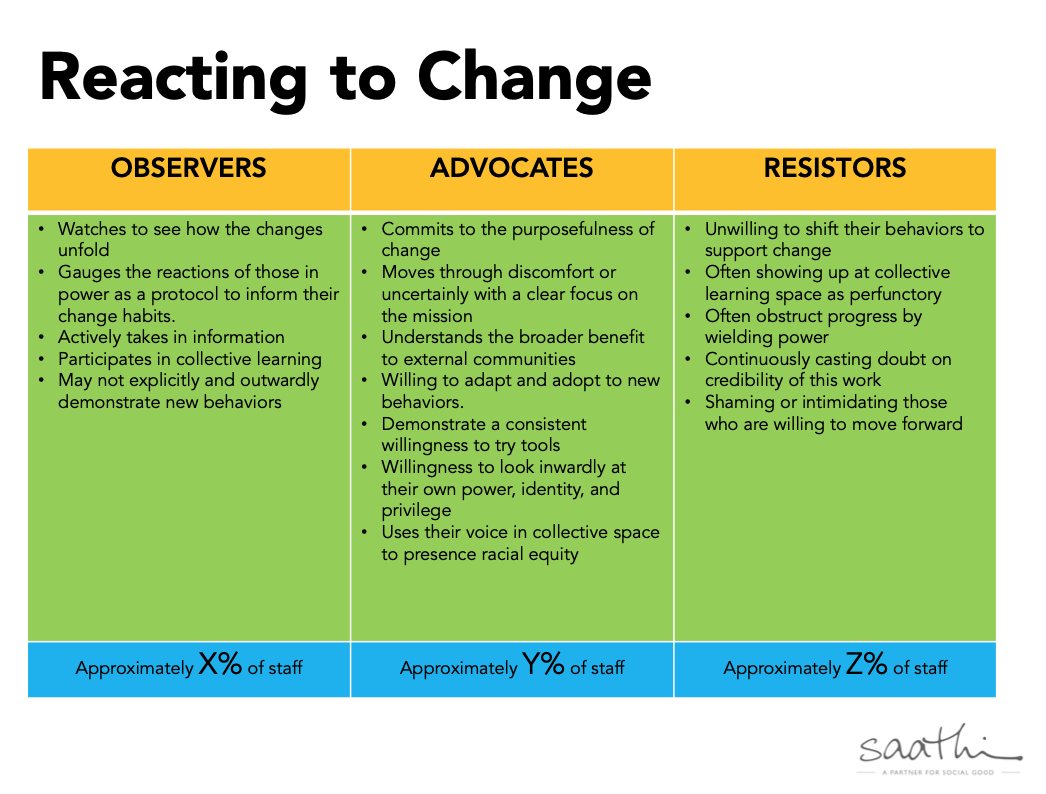
This is one way to consider how individuals show up in organizational change towards more active practice of equity and inclusion. Often I see that a majority of staff and board fall into the Observers category, while a small few as the consistent vocal Advocates for progress. Often, folks move among these categories depending on a variety of factors related to their intersectional identity, positional power, connectedness to the issue/topic and/or well-being.
The critical issue for many organizations is that Resistors wield extensive influence, authority, and power - meaning their power is exponential in relation to them being a smaller minority in the organization. Because of this, there are so many ways they can thwart and obstruct progress, both publicly and privately. That's another blog post.
Here are a few tools to navigate this:
First, re-center on Advocates and Observers.
Resistors will deplete the fresh air and energy around equity and inclusion work with little outcome to show for your efforts. We get distracted by these obstructionists and we all just really want people to want to do this work. Frankly, some people just don't want to. Refocus on those who are willing to try, to sort out confusion, those who will show up and participate. Normalize showing up. Support those who are willing to speak up and try. Invest in team members who are ready.*
*(note: willingness might also mean folks are unsure of what they should do. Willingness and expertise/certainty are different. You can create space for knowledge and tools to manage the uncertainty of what to do).
Remember, maintaining a focus on Resistors comes at the expense of the people who are the Advocates and Observers. It causes harm and pain to individuals who are ignored, overlooked, silenced, sidelined, censored, or otherwise marginalized (DEI Committees with no budget, leadership support, or organizational authority for example). It puts the work on the defensive and fails to seize upon the energy and vision of Advocates and Observers. Focusing on resistors harms those who hold racialized experiences, who are ready to show up for the mission and those who want to ally. Ask yourself - who is being centered in our work? Who benefits or does not benefit? What can we do to shift our gaze?
Second, show you believe in possibility.
Given overworked staff and underfunded budgets, we must choose to invest staff time and organizational resources wisely and with intentionality towards equity. Invest where change can happen - where opportunities exist. Design for change, progress and for opportunity.
Invest in supporting your DEI committee team members. Ask yourself, “What do our folks out in front need to keep going? Lunch? A break? A shout-out? A budget line? Time on the agenda?”
Design to deliver what you can to keep moving forward. Demonstrate that you believe everyone can lead on this work, that everyone plays a role and that opportunity to do better is abundant.
Third, create space for Resistors.
After re-centering on what's possible and finding your change-agents, turn to the Resistors. Consider asking them questions about why they feel like this is not mission-critical work, why they experience this work as not essential and what in their experiences leads them to disengage? Ask lots of questions, but choose them carefully. The questions should come from a place where you are centered in how they will show up or not, not if they will. They are meant to turn reflection back to the individual, not put you on the defense to justify this work.
Also, create specific and curated, facilitated spaces for Resistors to engage. The pain and harm resistors can cause when unchecked (or when their voices are the loudest and centered one) is immense. Create opportunities for 1:1 coaching and smaller, more focused learning spaces.
Consider experimenting with new DEI practices which allow folks a bit of space to see that everything is not being dismantled at once — that they still have a space to show up in their own identity and that they can learn and test alongside their peers. Experimenting helps organizations and their staff unfold and practice new ways of behaving and working, without the condition of it being "permanent."
Fourth, create spaces of proximity.
One the best ways to break bias and resistance is to get folks out of their own shell and into new experiences. Get them out of the office, show up with new movies and videos, host your meeting in a community space, go to new restaurants for lunch. Get closer to spaces that do not reinforce homogeneity and white-dominant cultural norms.
Fifth, go easy.
You can't change everyone. Be gentle with yourself and your colleagues.
Lastly, patience.
The goal of engaging Resistors is not to start conflict or to shame people. It is to practice the work of inclusion from love and grace. You must aim to embody this work and model it, even when tested. Our work is to create a movement — among those who are willing, who hold wisdom and experience and who are brave and loving. It is to welcome those who will participate and to be purposeful in our efforts. Our work is to make DEI and racial equity normal; showing that we can indeed create the future with our work now.
Now, take a deep breath, and go find your people.
Three Weapons of White Supremacy
White supremacy is designed to thrive and flourish on speed, silence and shame. An essential part of racial equity work is to understand that injustice, inequity, exclusion and domination are happening right now in our systems; in this very moment. There is no “neutral” in systems of oppression.
Speed. Silence. Shame.
“White supremacy is designed to thrive and flourish on speed, silence, and shame. An essential part of racial equity work to understand that injustice, inequity, exclusion and domination are happening right now in our systems; in this very moment. There is no neutral in systems of oppression.”
Speed. Silence. Shame.
White supremacy is designed to thrive and flourish on speed, silence and shame. An essential part of racial equity work is to understand that injustice, inequity, exclusion and domination are happening right now in our systems; in this very moment. There is no “neutral” in systems of oppression.
White supremacy asks all of us to comply with the status quo— smooth sailing and business as usual used as norms that allow for compliance, seeking to oppress action towards undoing systems of oppression in many ways. Here are three of the central ways white supremacy seeks to preserve itself and enforce compliance.
Speed.
We are all so busy we don't have time to think of what to say to disrupt the status quo. We fail to recognize that the current system is designed to sideline the essential processing, thinking, feeling and resiliency-building to move racial equity forward. It makes it feel like this work is separate from our "normal" work and takes "extra time" that is just not available.
Silence.
Business as usual means we stay quiet. We question how to say something, what to say, if we are the right ones to say it, when to say it, etc. — and the result is silence. We end up being quiet bystanders while harm is happening right in front of us. And in that moment of silence, of no interruption even if imperfect, the harm continues to be normalized, as does silence.
Shame.
Connected to silence, we stay quiet because of wanting to be right, perfect or an expert and it gets in the way of saying anything at all. We question how to say something, what to say, if we are the right ones to say it, when to say it, if we know the perfect phrase — we get lost in all of the "rightness" and the inability to humbly be wrong - trapped in shame and fear. We don't want to interrupt the agenda, the conversation, the preaching, or the light banter at the dinner table. We don't want to be the one that is too heavy or serious. We don’t want to be the radical.
The shame white supremacy wants you to feel is not real. Consider different ways to interrupt the status quo so it is not always a burden that can drown out its effectiveness and purpose. Acknowledge that this is hard and that some days won't be your day for this kind of work. That's ok. Also remember, that some people will choose conflict and confrontational no matter your approach. Choose your wellness and safety first. It is also ok to say what you need to say and leave. You don't have to be engaged in the whole thing if it hurts your humanity.
Just try to take a deep breath and remind yourself that the shame is not about you —it's about the the system.
Practice truth-asking.
We must develop a practice of curiosity. Asking better questions humbly and courageously can help us unveil white supremacy in systems, norms and business-as-usual. Ask why 5 times: why do we do it this way? Who decided this? Ask what has never been questioned before. Investigate who benefits from complex systems. Ask not only about what you are giving, but what you are withholding. Ask more truthful questions to more deeply investigate systems and norms. Practice responding to urgency not with the tools of the status quo, but the tools of liberation, belonging and equity.
So what can we do?
Practice creative reflection: a moment to reset yourself and see the reality of what is happening so you can choose to show up differently.
Our work is so deeply urgent we have to learn to show up differently.
Take an extra 15 seconds to reflect on the words you use, to breathe, to stretch. Take 10 minutes before a meeting you know might raise racial inequity or power issues and prepare yourself with notes, questions, inspiration and allies. Take the time to center yourself on racial equity, justice, belonging, and liberation. Reconnect to your purpose in this work.